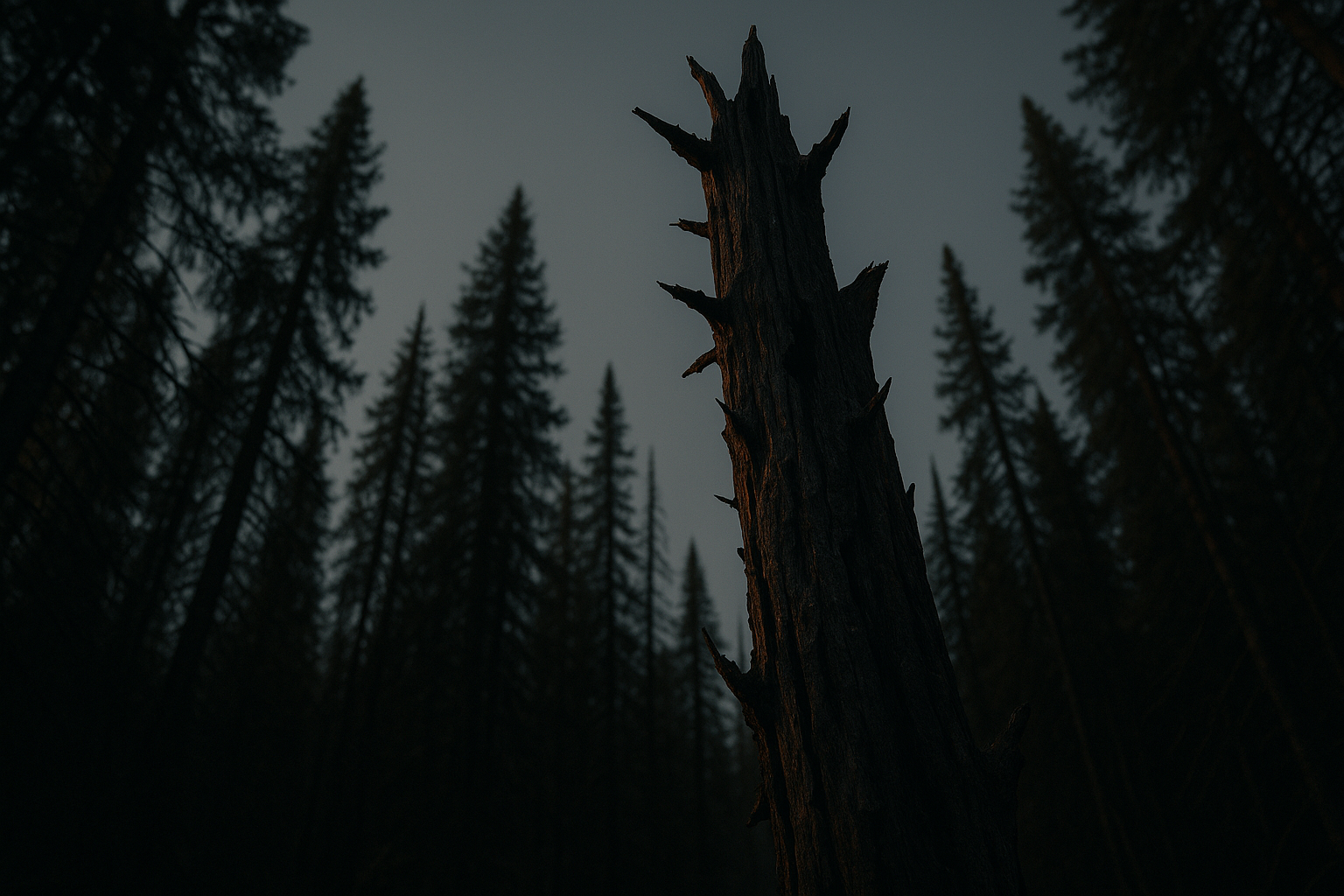
Spot Standing Dead Timber
A tree doesn't have to be down to be dangerous. Dead standing wood fails without warning.
Bark loss, no fine twigs in the crown, grey or silvered wood, fungal shelf growth at the base.
A dead tree can drop limbs or fail at the trunk without warning, especially in wind or after a freeze-thaw.
Treat any standing dead tree within one and a half tree-heights of your site as a hazard — move the site, not the tree.
Sight the trunk top to bottom from a distance; a tree missing its fine branch structure against the sky is dead, not just bare for the season.
Assuming a tree is safe because it's still upright. Standing dead trees fail at the base or mid-trunk, not only from falling limbs.
Check for Hung Limbs and Broken Tops
This is the true widowmaker — a limb that's already broken and held only by friction.
Broken limbs caught in the canopy above, snapped tops leaning on neighboring branches, fresh splinters or bark on the ground beneath a tree.
A hung limb can come down at any time, including in still night air — it doesn't need wind, only time.
Look straight up and turn a full circle at your intended sleeping spot before you commit. Move if anything is hung within falling reach.
Fresh debris on the ground below a tree is the tree telling you what it just dropped — treat it as an active hazard.
Choosing a site under a big, sheltering-looking tree because the canopy blocks rain. Canopy cover is not structural safety.
Read Leaning Trees and Root Health
A leaning tree with a failing root system can go over in wind that wouldn't bother a healthy one.
Trees leaning further than their neighbors, soil mounded or lifted on one side of the base, cracked or exposed roots.
Root heave and base cracking mean the tree is already moving, not just naturally angled.
Give any leaning tree clearance equal to at least its full height.
Fresh soil cracking or a widening gap at the base on the uphill side of the lean signals active movement, not old settling.
Only checking trees directly overhead. A leaning tree two site-widths away can still reach your shelter if it goes over.
If you find one dead or hung hazard within reach of a site, run a full 360° hazard scan before building. If you find two, move the site rather than just clearing the one you found.
Clearing brush and low branches but never looking up. Ground-level tidiness has nothing to do with overhead hazard.
Look up first. A clean floor means nothing under a dead tree.