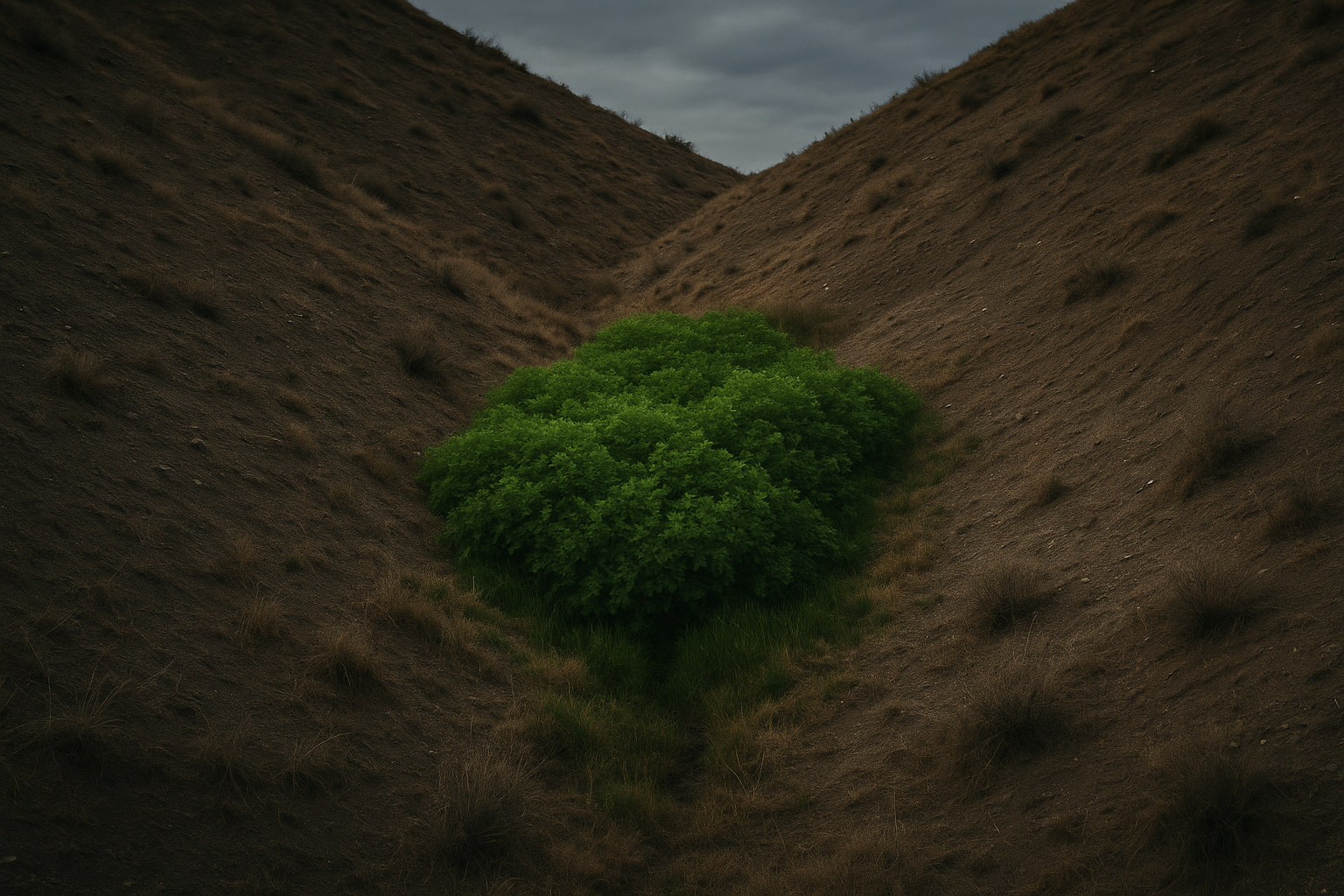
Read the Vegetation
Plants that need consistently wet roots are the most reliable free indicator you have.
Patches of vivid green that stay green through dry spells — sedges, rushes, cattails, watercress, or moss concentrated in one spot on an otherwise dry slope.
A green patch that outlasts the surrounding dry ground is usually sitting over shallow groundwater.
Mark the greenest, lowest point of the patch and dig a small test hole there, not at the edge.
Dig 20-30cm down; damp, dark soil or slow seepage confirms groundwater near the surface.
Assuming green means safe to drink. Green means wet, not clean.
Follow the Slope Break
Springs surface where the ground's angle changes, not randomly across a hillside.
A sudden change in slope angle — a bench, terrace, or the base of a scree slope — especially where rock meets soil.
Water moving through porous rock or soil often surfaces where the ground abruptly flattens or meets an impermeable layer.
Walk the slope break itself rather than the open hillside; springs concentrate along these lines.
Look for damp, darker soil, mineral staining, or a slight depression with no obvious inflow channel.
Searching only at the bottom of a valley. Many springs emerge partway up a slope, well above the valley floor.
Watch Animal and Insect Sign
Wildlife finds water more reliably than a first-time visitor — use it to narrow your search.
Converging game trails, insect activity clustering, bird activity concentrated in one area, especially in otherwise dry terrain.
Trail convergence is a strong secondary indicator, not a primary one, and works best combined with vegetation and slope-break signs.
Use convergence to narrow your search area, then confirm with the other two signs.
Follow converging trails uphill rather than downhill; most lead toward a source, not away from one.
Following a single trail without confirming convergence — one trail can just as easily lead to a bedding area.
A green patch, a slope break, and trail convergence all in the same general area is a high-confidence spring site worth digging. One sign alone is a lead, not a confirmation.
Treating any of these signs as proof of drinkable water. All of them indicate wet ground — none of them indicate clean water.
Green tells you wet. Only treatment tells you safe.